The Death of Process
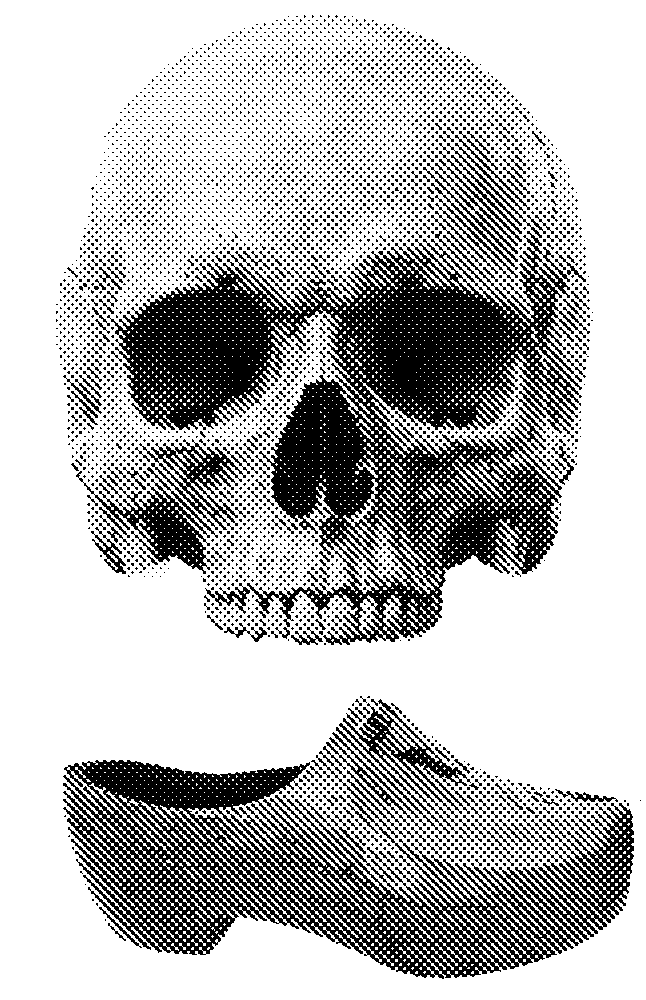 The Industrial Revolution was more than 200 years ago, and gave rise to everything from Capitalism and Communism to the assembly line to a vast, global increase in wealth and standard of living. It also supercharged labor exploitation in a variety of forms including the expansion of slavery in America. We tend to think of the Industrial Revolution as a 19th century occurrence, but it started in the late 1700s, (Joseph-Marie Jacquard invented the programmable loom in 1790 and rolled it out in 1801) and really hit high speed in the 20th century. In short, the entirety of what we consider the modern world.
In a gross oversimplification, the Industrial Revolution was about increasing attention to and optimization of process. Every part of every process. We have spent more than two centuries identifying, refining, and optimizing every part of every process. There are libraries full of books about how to create better processes in everything from transport, to fabrication, to agriculture, to learning, to how to get humans to better operate within these processes, to life-maxing. I would guess if you look around yourself right now, nearly every object, including what you're wearing and what is in your belly are results of process optimization.
Single refinements of a part of a process had massive societal impacts, looking just at the mechanical loom and the cotton gin. We're not even talking about steam engines or electricity or the internal combustion engine.
We have been trained on Process and our focus on it has fundamentally redefined our entire world. Many of us have advanced in our careers because we can identify and break down complex processes into manageable and optimizable steps. We are not only really good at it, we really enjoy doing it.
So what happens if Process no longer matters? What if we no longer had to care about how something was made, the infinite number of steps that go into the pipeline of making things, and handing them from one atomic part to another? This is what agentic workflows unleash. This is what Anthropic, et al. are asking us to do, and it's a real mind bender.
The advice Anthropic gives for creating agentic workflows is to explicitly not begin with Process. All those highly optimized modules and systems you've developed or employed over the years are great, and possibly supportive, but definitely ancillary to the new way things come into our world.
Anthropic advises you to begin with the goal and your eval harness. Define your goal. Give it proper context, and, critically, define your evaluation systems. Make them quantifiable if possible, qualitative if not, and combine the two as necessary. The better your eval harness, the faster and better the results. Define your results. Do not worry about the process. At all. It no longer concerns you. At all. The only metric is, are you getting the results you want.
Let that sink in. This is not just a new way of working, it is a new way of thinking about work. It is a new way of thinking about value, about employment, about resources, about time to market, about market.
The work to create these agentic systems is front-loaded. Because once the eval harness is clearly defined and implemented, it can be self monitoring and self healing. Done correctly, it never needs to be touched until you want it to do something else. Done poorly, it doesn't work, or creates a feedback loop.
So as we wade into this narrow window of a shoulder season of society, the obvious first step many of us are going through is thinking about how to adapt or redefine our existing pipelines.
How to Think About Your Pipeline
Here is the rubric I apply:
At a high level this is how we look at work:
What can be automated in an efficient, deterministic manner: Solved Problems vs Unsolved Problems. Solved Problems are the lowest hanging fruit. LLMs and vibe coding tools are trained on the modern corpus of efficient code creation and libraries, so any solved problem is now trivial to build and deploy. This is what many of us have spent the last couple of years identifying and refining.
For Agentic workflows, the evaluation criteria change to Defined vs Undefined Inputs and Goals. If we can create an evaluation harness, then an agentic system can produce it. It does not matter whether the problem is Solved or Unsolved, what matters is whether we have a solid evaluation system.
When looking at your pipeline, look at the type of work that needs to be done:
Manual
Does it need to be? Are you sure? If yes, why?
Automated
Already automated. Is it Modular? Sequential? Optimized? Incorporated into the larger pipeline? Can it be incorporated as an optimized tool or skill in an agentic system or would that slow down the system?
Generative
Work that requires us to create something based on inputs: reports, slide decks, schedules, descriptions, images, text, analysis, etc.
Interpretive
Looking at something and deciding what should happen to it: categorization, quality, non-obvious relations, etc. (this is a sub-genre of generative) with gold standard outputs, Claude can already do this very well. Classifications, ratings, taxonomy — that's all interpretive work. Taxonomies are key, but their role probably migrates to become about context and gold star examples based on explicit definitions. It becomes verbose. Having gold standard outputs and edge cases virtually guarantees success. Ironically, the people handling taxonomies are probably in the best position to create and grade the agentic evals of a fully automated system.
Human
Interpersonal, and nuanced cultural and emotional work still needs talented humans. The more something needs to have emotional weight, cultural implications, or high stakes for a business / customer relationship, the more we want humans to be hands on. Those things should not be automated, but they may need better tools which involve automation.
Where trust is lowest and stakes are highest, we need humans in the loop. We also need humans to be able to override defaults and production because an agentic system's job is to achieve the desired goal as accurately and as efficiently as possible. It does not care about humans. Surely you've read or seen some sci-fi stories in your time.
We are sprinting into a world where creating things is not the gating factor: managing humans is. Change management and trust in the systems are the two biggest hurdles we are now facing.
The first programmable loom was created by Joseph-Marie Jacquard in 1790 and rolled out in 1801, and the city of Lyon rioted. (Fun fact: we get the word sabotage from these riots, wherein the French silk workers threw their wooden shoes, sabots, at the machines to destroy them.) A few years later, in England, the Luddites rioted and burned power looms. They were rightly terrified, and they reacted appropriately, given the tools at their disposal. No one gave them an offramp or an alternate plan.